
Under the name hap ceramics, Berlin-based ceramicist Maxi Hoffmann creates tactile, sculptural objects that push the boundaries of glaze and form.
Born in 1988 in Karl-Marx-Stadt, Germany, she has lived, studied, and worked in New Zealand, Austria, the Netherlands, and Great Britain before settling in Berlin in 2024. Her deep connection to craftsmanship, design, and art was shaped early on — growing up with a ceramicist mother, an art teacher grandmother next door, and the lasting influence of her great uncle, the product designer Clauss Dietel.
Hoffmann’s practice explores the boundaries of ceramic material by questioning the conventions that traditionally define the craft. Having grown up with a mother trained as a ceramicist in a tradition centered on technical precision and mastery, she became familiar with the discipline and expectations of the material from an early age. Rather than reinforcing these inherited conventions, her work investigates what happens when their rules begin to loosen.
A central aspect of her practice is a building technique in which clay slabs are joined through rough pinching instead of being carefully smoothed. The seams and fingerprints remain visible, allowing the gestures of making to become part of the object’s structure and surface. What is traditionally corrected or concealed becomes a defining element of the work.
Alongside this construction method, Hoffmann developed an experimental surface treatment called Lunar Glaze. In conventional ceramics, glaze forms a thin decorative and protective layer that seals the clay body and makes it more durable. Lunar Glaze behaves differently: it expands across the ceramic surface like a second skin, sometimes growing several centimetres beyond the clay body and transforming the glaze into a material presence of its own.
Through these processes, Hoffmann’s work moves between design, craft, and sculpture. The resulting objects often resist familiar typologies and challenge expectations of what ceramic objects should look like or how they should behave. By allowing traces of construction and material excess to remain visible, her work explores the tension between discipline and departure, control and material autonomy.
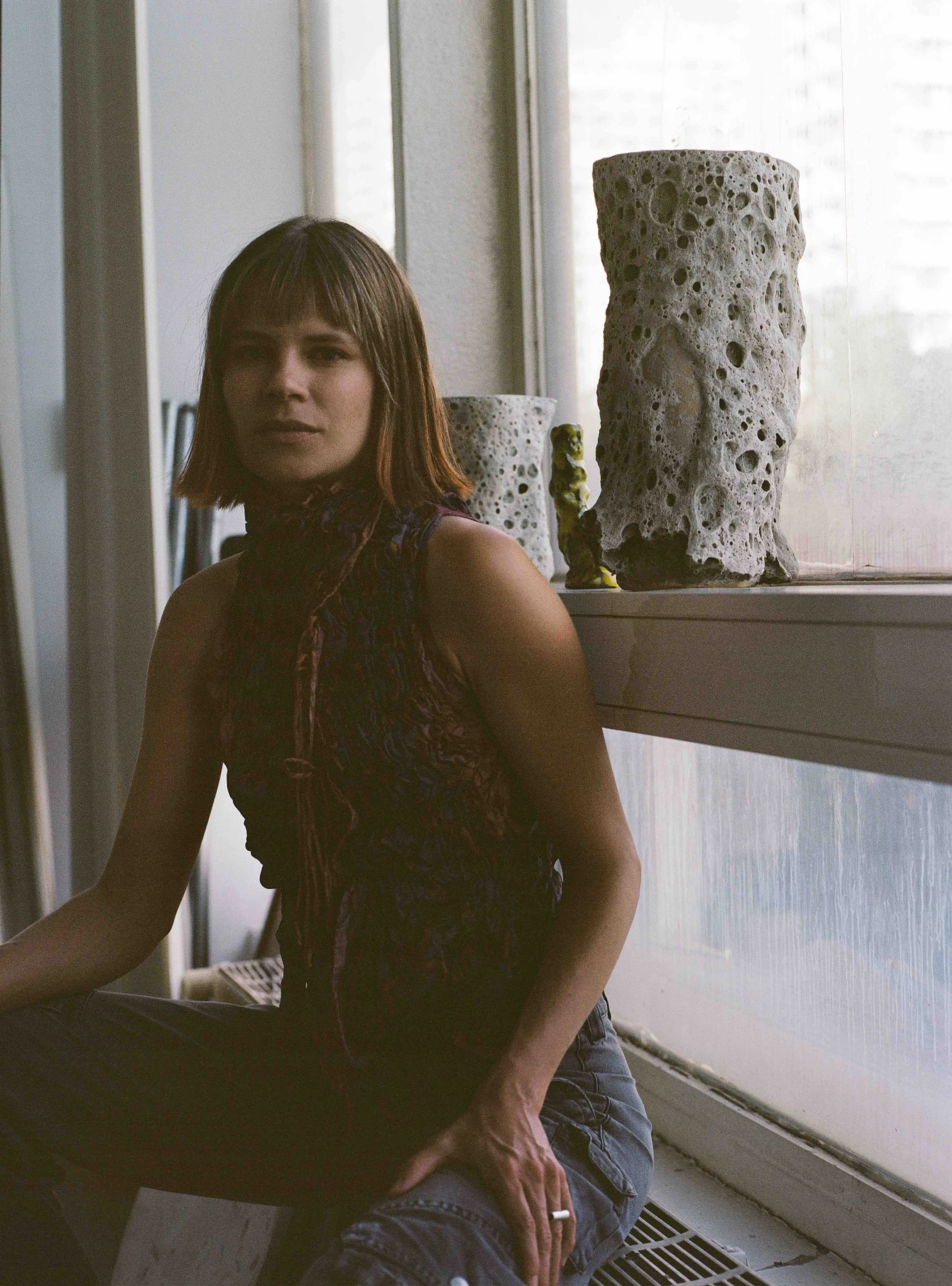
Portrait by Lukas Städler.